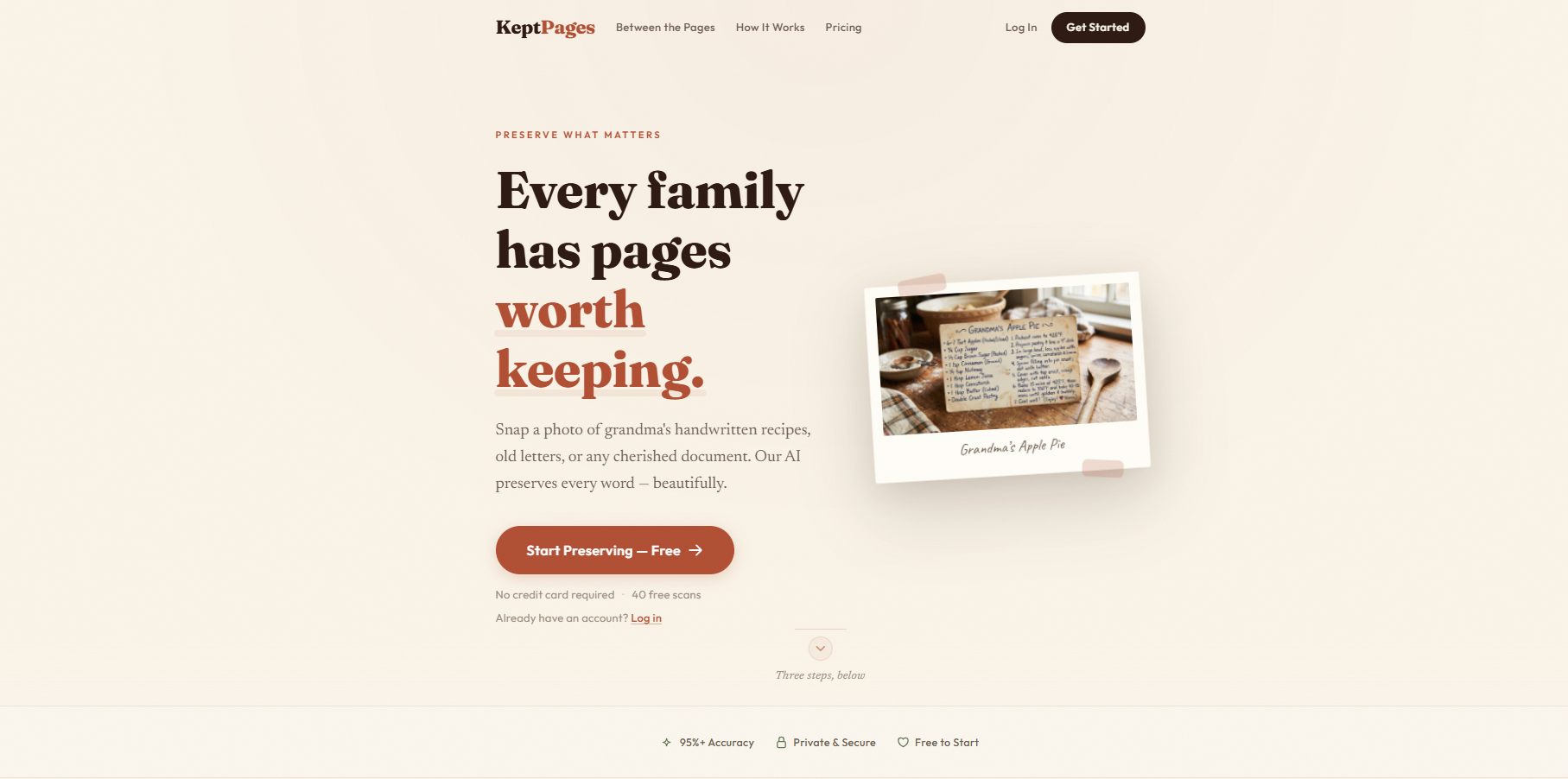
KeptPages started as a personal problem. I wanted to preserve my mother’s and grandmother’s handwritten recipes, the kind written on stained index cards in two generations of handwriting, and I couldn’t find an option online that I trusted to do it well. So I built one.
The product is a mobile-first web app that lets users scan handwritten recipes, letters, or journal pages with their phone, review and correct the AI’s extraction, and design a hardcover book to print and keep. It went into closed trial in early 2026 with 10+ active testers, ahead of a Mother’s Day 2026 public launch.
The design challenge was a stack of constraints in tension. The source material is emotional, handwriting from family members, often deceased. The AI extraction is imperfect, since handwriting recognition has real failure modes. The end user is rarely a designer, and shouldn’t need to be.
Each of those pulled in a different direction: toward warmth, toward honesty about what AI can and can’t do, toward simplicity in the book-design stage. The product had to hold all three without compromising any of them.
Built AI trust through visible confidence, fallback models, and an explicit review step.
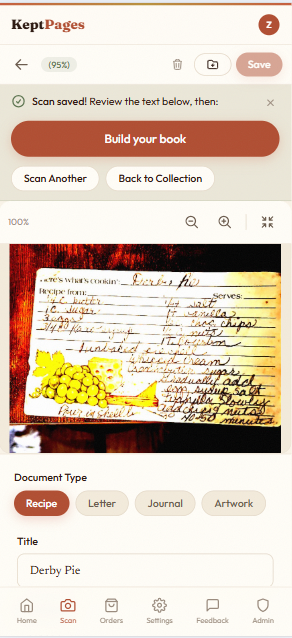
The most common AI-product UX failure is the confident wrong answer, where the system says “here’s the text” and the user trusts it. I designed the opposite. Gemini does the initial extraction and surfaces a confidence score on every scan. If confidence is low, the user can swap to Claude as a fallback model and re-extract. The user can always edit the extraction directly.
The pattern works because it doesn’t hide the failure mode. It makes the user’s review the most visible part of the flow, rather than something tucked away.
Chose a warm cream palette and serif typography over modern tech-product UI.
The visual identity references the source material. Recipe cards are cream-colored, worn, written in ink. A bolder palette would have signaled tech app and undercut the emotional weight of what the user is actually doing: preserving something from a person they love. The design should fade into the background of the memory, not compete with it.
Redesigned the scan-to-book connection after tester feedback.
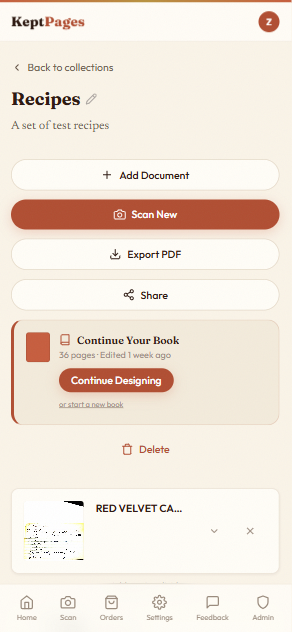
The biggest signal from the closed trial: scanning and storing recipes felt complete, so users weren’t continuing into book design. The two halves of the product felt like two separate products. I added inline prompt cards that appear once users have built up enough content, drawing the connection to physical book creation.
The flow still isn’t where I want it. Bridging the mental shift from “small task” to “project” is a real design problem that messaging alone may not solve.
Switched from subscription to a one-time Keeper Pass.
The product was originally modeled as a subscription. I switched to a $59.99 one-time purchase because the subscription model was misaligned with the user’s mental model of the work. The promise of KeptPages is “preserve this forever.” A subscription that could lapse undermines that promise, especially for users digitizing a deceased relative’s recipes, who don’t want a recurring charge hanging over the project. The business model now matches the emotional contract.
Built as a mobile-first PWA to keep the camera step frictionless.
Users scan in real-world settings: in the kitchen, at a relative’s house, going through an old box of papers. Friction at the capture step kills the product. A PWA means no install, no app store, no friction between “I’m holding this card right now” and scanned-and-saved.
AI-trust UX isn’t a single design problem. It’s an ongoing one. As Gemini and Claude get better at handwriting, the confidence-score language and the review prompts will need to evolve. The current pattern is honest about failure modes. The next iteration also needs to be honest about improving capabilities, without lulling users into skipping the review step entirely.
The flow connection between scanning and book design is the thing I’ll keep iterating on. The prompt cards helped, but the underlying tension is real: scanning feels immediate, book design feels like a project. That may need a structural solution, not just better messaging.
Public launch is timed to Mother’s Day 2026.